Water Security
Backup Water Storage for Businesses: Planning for Municipal Supply Interruptions
How South African businesses, healthcare facilities and residential developments can plan backup water storage that keeps them running when municipal supply fails.
For many South African businesses, a day without municipal water is no longer a rare event. Planned maintenance, burst mains, reservoir and pump station problems and power interruptions at pumping infrastructure can all leave a site without supply, sometimes for longer than expected. When that happens, toilets close, kitchens stop, production halts and tenants start asking questions.
A properly designed backup water storage system keeps the site running until supply returns. This guide covers how to plan one, from deciding what to protect to the details that keep stored water safe to use.
Key takeaways
- Start by identifying the water uses that must keep running during an interruption. Backing up only critical uses can reduce the storage needed considerably.
- Size the storage from measured daily demand multiplied by the number of days of autonomy the business needs.
- A backup system is more than a tank. Pumps, controls, valves and power supply decide whether the stored water reaches the taps.
- Potable backup water needs a suitable tank lining, a sealed tank and regular turnover to keep water quality acceptable.
Who needs backup water storage?
- Healthcare facilities, where water is needed for hygiene, sterilisation and patient care at all times.
- Data centres and plants with cooling loads, where a loss of water can mean a loss of cooling.
- Shopping centres, offices and commercial property, where landlords have obligations to tenants and cannot keep ablutions open without water. See commercial water storage tanks.
- Residential estates and multi-unit developments, where hundreds of households depend on one connection. See bulk water storage for residential developments and estate water storage systems.
- Manufacturing and processing sites, where production stops when water stops.
Step 1: Identify critical water uses
List every use of water on the site and rank it. Ablutions and drinking water are usually critical. Process water may be critical for production. Irrigation and vehicle washing rarely are. Separating critical from non-critical uses, and arranging the plumbing so the backup supply feeds only the critical ones, is often the most effective way to reduce the size and cost of the system.
Step 2: Decide how long the site must keep running
Look at how long supply interruptions in your area have lasted and what downtime costs the business. Then agree a target, for example 24 hours, two days or longer for critical facilities. Multiply that by the measured daily demand of the critical uses to get the usable volume you need. Our bulk water storage tanks and backup water storage tanks page explain the options in more detail.
Step 3: Design the whole system, not just the tank
Stored water is only useful if it reaches the taps at the right pressure. A typical backup system includes:
- The storage tank, sized for the usable volume and designed for the site's footprint and foundations.
- Automatic refilling from the municipal connection, with a valve that tops up the tank whenever supply is available.
- A booster pump set with pressure control, sized for the peak flow of the critical uses.
- Backflow protection so stored water cannot flow back into the municipal network.
- A bypass so the site can be supplied directly from the main during tank maintenance.
- Level indication and alarms so facilities staff know how much water remains during an outage.
Do not forget power
Booster pumps need electricity. If power and water interruptions can occur together, the pump set should be connected to the site's backup power supply. Where the site layout allows, an elevated water tank can supply water by gravity and reduce dependence on pumps.
Keep fire water separate
Backup domestic water and sprinkler water serve different purposes. Fire water is sized by the fire engineer and must never be drawn down by domestic use. If both are stored in one tank, the outlets must be arranged so the fire reserve is protected. See our fire protection water storage tanks page.
Step 4: Protect water quality
Water used for drinking, food preparation or hygiene must stay safe while it is stored. Good practice includes:
- A tank with a water-side surface suitable for potable water, such as hot-dip galvanised sectional panels or a food-grade PVC liner.
- A sealed roof, screened vents and lockable access hatches to keep out dust, insects, animals and unauthorised access.
- Regular turnover, so stored water is used and replaced rather than standing for long periods. This is one reason not to oversize a potable tank.
- Periodic inspection and cleaning, scheduled so the site is not left without backup while the tank is out of service. A two-compartment sectional tank allows one half to be cleaned while the other remains in use.
Step 5: Check compliance and approvals
Water installations in buildings in South Africa are governed by municipal water by-laws and by standards such as SANS 10252-1 for water supply installations in buildings. Connecting storage and pumps to a municipal supply may require approval, and backflow prevention is generally required. Videx steel water tanks are designed to SANS 10329. Your wet-services engineer or plumber should confirm the requirements of your local municipality before installation.
Choosing the right tank
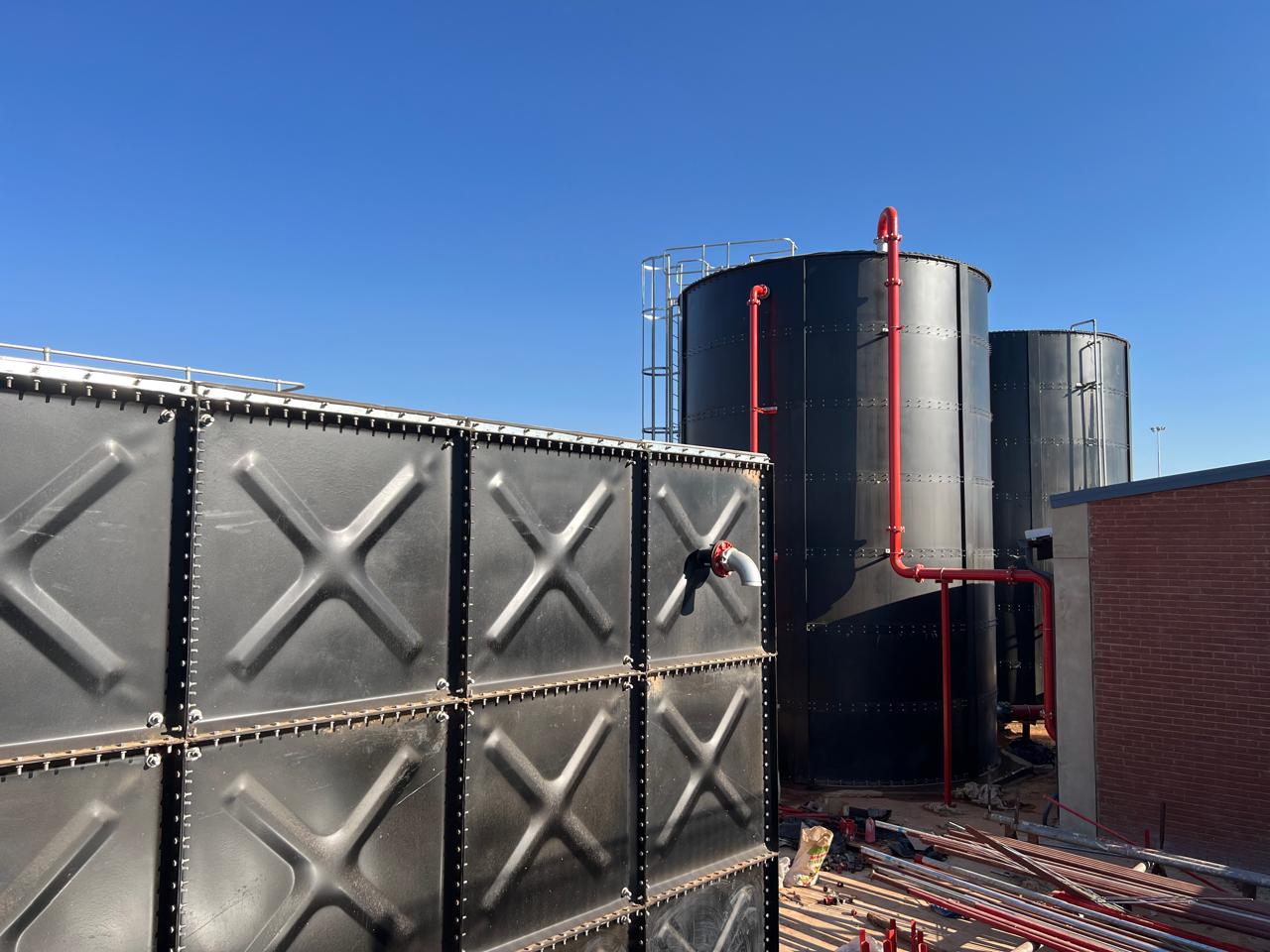
For sites with limited or rectangular space, a sectional steel water tank can be configured to fit and split into compartments. For open sites and larger volumes, a round steel water tank with a food-grade PVC liner may suit better. Both are manufactured by Videx in Wadeville, Gauteng.
Examples from Videx projects
- Fourways Mall: a 1.85 million litre bulk water storage system for a major retail destination.
- Fleurhof Mall: an integrated water storage system for a shopping centre.
- East Rand Mall: bulk commercial water storage in a compact footprint.
Frequently asked questions
How much backup water storage does a business need?
Multiply the measured daily consumption of the uses that must keep running by the number of days the site needs to operate without supply. Add any planned growth, and ask your supplier to convert the usable volume into a nominal tank size.
Can backup water storage be used for drinking water?
Yes, provided the tank is suitable for potable water, sealed against contamination, and the water is turned over and the tank maintained regularly.
Do I need booster pumps with a backup water tank?
In most cases, yes. A ground-level tank needs a pump set to deliver water at usable pressure. An elevated tank can supply water by gravity, which reduces reliance on pumps and power.
Do I need municipal approval for a backup water tank?
Requirements vary by municipality. Connecting a tank and pumps to the municipal supply usually involves backflow prevention and may require approval. Check with your local municipality or a registered plumber before installation.
Can the backup tank also store fire water?
It can, if the outlets are arranged so the fire reserve can never be used for domestic supply and the arrangement is approved by your fire engineer. Many sites keep fire water in a separate tank to avoid this risk.
This article provides general guidance only. Backup water systems should be designed by a qualified engineer and installed in line with your municipality's by-laws and the applicable standards.
About this article
Written by the engineering team at Videx Storage Tanks, a South African manufacturer of steel water storage tanks based in Wadeville, Gauteng, with a branch in Bellville, Cape Town. Videx has more than 40 years of experience and more than 500 completed projects, and is ISO 9001:2015 certified.
Planning backup water storage for your site? Speak to a Videx engineer about capacity, tank type and layout.