Product Guides
How to Size a Bulk Water Storage Tank for a Commercial or Industrial Site
A practical, step-by-step method for working out how much water storage a commercial or industrial site needs, with a worked example.
Choosing a water storage tank starts with one number: how much usable water the site needs. Size the tank too small and it runs dry during the outage it was bought for. Size it too large and the client pays for steel, foundations and space they never use, and potable water sits in the tank long enough to raise quality concerns.
This guide sets out the method our engineers use to arrive at a defensible capacity for commercial and industrial sites, with a worked example you can adapt.
Key takeaways
- Start with measured consumption, not estimates. Municipal bills and sub-meters are the most reliable source.
- Decide how long the site must run without supply. That figure, multiplied by daily demand, is the core of the calculation.
- Fire water is sized separately by the fire engineer and added only if it is stored in the same tank.
- Convert the usable volume you need into a nominal tank size, then check it against the footprint, foundation and refill rate.
Step 1: Establish daily water demand
Use the best data available, in this order:
- Metered consumption. Twelve months of municipal bills or sub-meter readings show average and peak usage, including seasonal variation.
- Comparable sites. Consumption from a similar building or plant you already operate.
- Design estimates. For new developments, the demand figures used by the project's wet-services engineer.
Separate the demand into the uses that matter. Domestic water for toilets and kitchens, process water for production or cooling, and irrigation do not all need to be backed up to the same degree. Many sites decide to back up only critical uses, which can reduce the required capacity considerably.
Step 2: Decide on days of autonomy
Autonomy is how long the site must keep operating on stored water alone. It is a business decision as much as a technical one. Consider:
- How long supply interruptions in your area have lasted in the past.
- What an hour or a day without water costs the business, including lost production, closed facilities or tenant claims.
- Whether the site has an alternative source, such as a borehole, that can top up the tank.
Hospitals, data centres and production plants often plan for longer autonomy than offices or retail. Write the chosen figure down and get it agreed by the client, because it drives the size and cost of everything that follows.
Step 3: Add fire water if it shares the tank
If the site has a sprinkler system, the fire engineer sets the required fire water volume from the hazard classification, design flow and required duration. If fire water is stored in a separate tank, keep it out of this calculation. If it is combined with domestic or process water, add the fire volume and arrange the outlets so the fire reserve can never be drawn down for other uses. Our fire protection water storage tanks page covers this in more detail.
Step 4: Allow for growth
A tank is expected to serve the site for decades. If expansion, additional tenants or higher production are planned, include that demand now. Adding capacity later usually means a second tank, a second foundation and more pipework.
Step 5: Convert usable volume to tank size
The volume you have calculated so far is the effective capacity: water that can actually be drawn from the tank. The nominal capacity of a tank is larger, because some water sits below the outlet and space is left between the overflow and the roof. The difference depends on the tank height, outlet position and fittings, so ask your supplier to state both figures.
Step 6: Check the site
- Footprint. Floor area needed is roughly the effective volume divided by the usable water depth. For example, 100 m³ of usable water at 2.4 m usable depth needs about 42 m² of internal floor area, plus space around the tank for erection and maintenance.
- Height. A taller tank reduces the footprint but may be limited by planning rules, foundations or access.
- Foundations. Water weighs one tonne per cubic metre, so the foundation must be designed for the full load.
- Refill rate. After an outage, the municipal connection or borehole must be able to refill the tank within a reasonable time.
- Elevation. If water must reach the site by gravity, an elevated water tank or tower may suit better than a ground-level tank with booster pumps.
Worked example
The figures below are illustrative only, to show how the method works.
A distribution centre's municipal bills show average consumption of 30 kL per day. Management wants the site to keep operating through a two-day supply interruption, and expects demand to grow by about 20% when a planned extension opens. Fire water is held in a separate sprinkler tank.
| Step | Calculation | Result |
|---|---|---|
| Daily demand | From 12 months of bills | 30 kL/day |
| Autonomy | 30 kL × 2 days | 60 kL |
| Fire water | Stored in a separate tank | 0 kL |
| Growth allowance | 60 kL × 1.2 | 72 kL effective capacity |
| Tank size | 72 kL effective, converted to nominal by the supplier | Nominal size quoted by supplier |
Changing the autonomy shows how sensitive the result is to that one decision:
| Days of autonomy | Usable volume at 30 kL/day | With 20% growth |
|---|---|---|
| 1 day | 30 kL | 36 kL |
| 2 days | 60 kL | 72 kL |
| 3 days | 90 kL | 108 kL |
| 5 days | 150 kL | 180 kL |
Useful conversions
- 1 kilolitre (kL) = 1,000 litres = 1 cubic metre (m³)
- 1 megalitre (ML) = 1,000 kL = 1,000,000 litres
- 1 m³ of water weighs approximately 1 tonne
Choosing the tank type
Once the capacity is known, the site layout usually points to the tank type. Sectional steel tanks can be configured to fit rectangular or narrow footprints, and Videx's standard square sectional tank sizes run from 1.82 kL to more than 559 kL. Round steel tanks suit open sites and bulk volumes. See our sectional steel water tanks and round steel water tanks pages, or our overview of bulk water storage tanks.
Projects sized by Videx
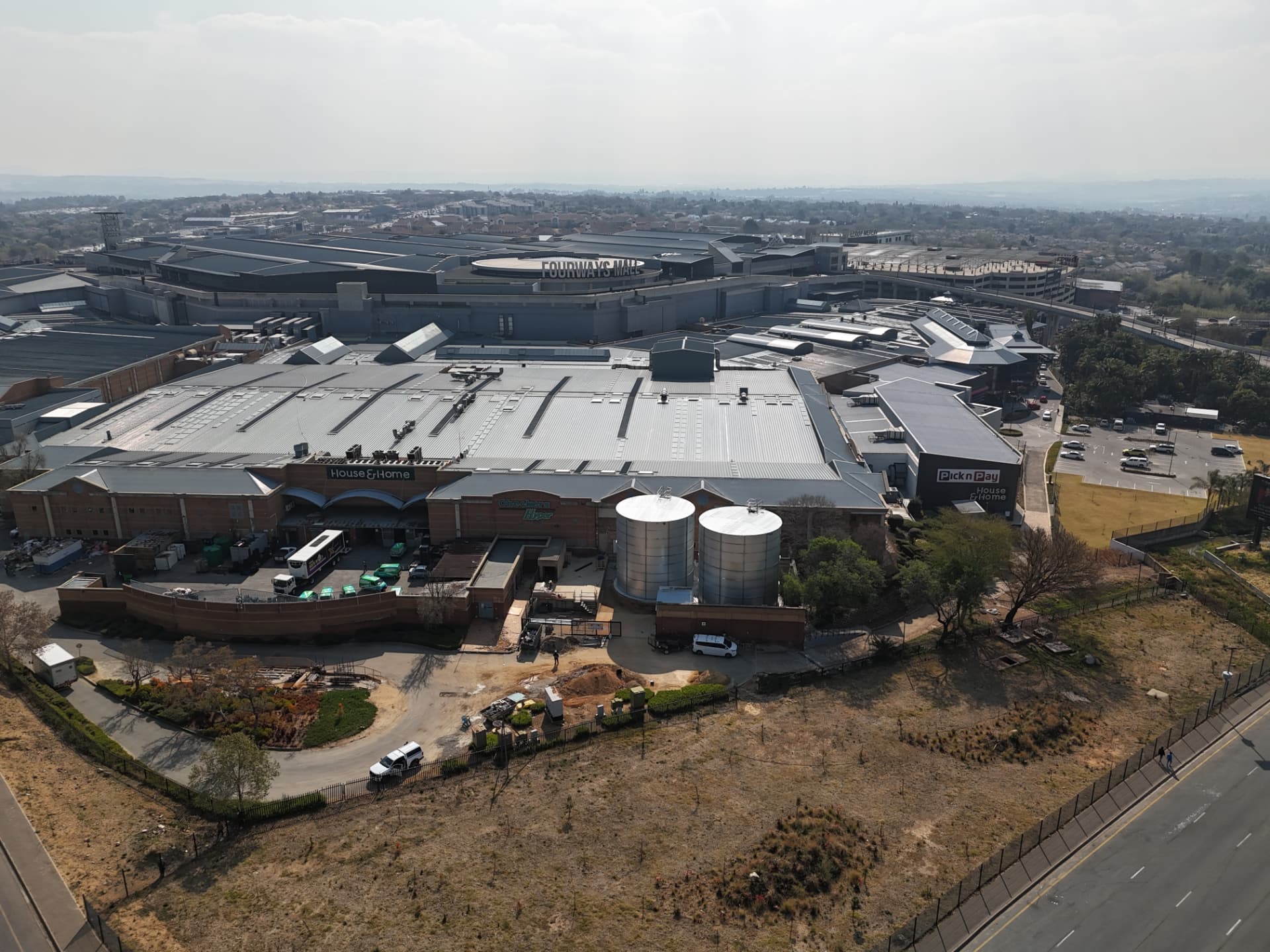
- Fourways Mall: a 1.85 million litre bulk water storage system.
- Kikuyu Lifestyle Centre: a 630 kL powder-coated water storage tank.
- East Rand Mall: a 103 kL cylindrical tank on a compact footprint.
Frequently asked questions
How many days of water storage does a business need?
There is no single answer. It depends on how long local supply interruptions last, what downtime costs the business and whether there is an alternative source. Critical facilities such as hospitals, data centres and production plants usually plan for longer autonomy than offices or retail sites. The worked example above shows how the choice affects tank size.
What is the difference between effective and nominal tank capacity?
Nominal capacity is the total internal volume of the tank. Effective capacity is the volume that can actually be drawn out, which is lower because some water sits below the outlet and space is left above the overflow.
Should fire water be included in the tank size?
Only if fire water is stored in the same tank. The fire volume is set by the fire engineer and must be protected so it cannot be used for other purposes.
How much space does a water tank need?
Divide the usable volume by the usable water depth to estimate the floor area, then allow working space around the tank. Your supplier will confirm exact dimensions for the chosen tank.
Can I size the tank from the number of people on site?
Per-person estimates can help at early design stage, but measured consumption is far more reliable. Where a site is already operating, always use metered data.
This article provides general guidance only. Final capacities, foundations and connections should be confirmed by a qualified engineer for your specific site.
About this article
Written by the engineering team at Videx Storage Tanks, a South African manufacturer of steel water storage tanks based in Wadeville, Gauteng, with a branch in Bellville, Cape Town. Videx has more than 40 years of experience and more than 500 completed projects, and is ISO 9001:2015 certified.
Want a capacity check for your site? Send us your consumption figures and a Videx engineer will help you size the tank. For industrial projects, see our industrial water storage solutions.