Product Guides
Sectional Steel vs Round Steel Water Tanks: Which Suits Your Project?
A practical comparison of bolted sectional steel tanks and round Aluzinc tanks with PVC liners, and how to choose between them for your project.
Most bulk water storage projects in South Africa come down to a choice between two steel tank types: a bolted sectional steel tank, which is square or rectangular, and a round steel tank with an internal liner. Both store large volumes reliably and both are built to SANS 10329. They differ in shape, in how the water is protected from the steel, in how they are maintained and in the sites they suit best.
This guide compares the two so you can go into a quotation knowing which questions to ask.
Key takeaways
- Sectional steel tanks are built from bolted, hot-dip galvanised steel panels and can be configured as squares or rectangles to suit the available footprint.
- Round steel tanks use an Aluzinc AZ150 coated steel shell with a food-grade PVC liner that holds the water.
- Site layout, water type, capacity, maintenance approach and timeline usually decide the choice, not the tank type alone.
- Both types are used for potable, process, backup and fire water storage. Ask for both to be priced if your site can take either.
What is a sectional steel water tank?
A sectional steel tank is assembled on site from standard steel panels bolted together, with sealant at the joints. Videx sectional tanks use hot-dip galvanised steel to SANS 121 and are designed to SANS 10329, with internal bracing to resist the water load.
Because the tank is built from modules, its length, width and height can be chosen to fit the site. Videx's standard square tank schedule runs from 1.82 kL to more than 559 kL, and custom sectional reservoirs can be engineered for much larger volumes. You can explore the standard sizes on our square sectional tank sizes and 3D model page, or read more about sectional steel water tanks.
What is a round steel water tank?
A round steel tank has a circular shell of Aluzinc AZ150 coated steel panels. In Videx round tanks, the shell is Aluzinc AZ150 coated steel and the water is held inside a food-grade PVC liner, so the stored water does not touch the steel.
The circular shape carries the water pressure as hoop tension in the shell. You can inspect a round tank in detail on our cylindrical tank specifications and 3D model page, or read more about round steel water tanks.
Sectional vs round: side-by-side comparison
| Factor | Sectional steel tank | Round steel tank |
|---|---|---|
| Shape and footprint | Square or rectangular. Length and width can be chosen to fit long, narrow or rectangular spaces. | Circular. Needs a round footprint plus working space around it. |
| Water contact surface | Hot-dip galvanised steel panels (SANS 121), sealed at the joints. | Food-grade PVC liner. The steel shell does not contact the water. |
| Corrosion protection | Galvanising protects the steel inside and out. | Aluzinc AZ150 coating on the shell, plus the liner as a barrier on the water side. |
| Design standard | SANS 10329 | SANS 10329 |
| Capacity | From small modular tanks to multi-megalitre reservoirs. Standard square schedule from 1.82 kL to 559 kL+. | Suited to bulk storage. Capacity set by diameter and height. |
| Compartments | Internal partition walls can create two or more compartments, for example a split fire tank. | Usually a single compartment. Multiple tanks are used where separate compartments are needed. |
| Maintenance focus | Inspect panels, bolts, sealant and internal bracing. | Inspect the liner and shell. The liner can be replaced without replacing the tank. |
| Typical uses | Fire water, potable and process storage, sites with tight or rectangular footprints, split tanks. | Bulk potable, process, agricultural and backup storage, mining and industrial sites. |
When a sectional steel tank is the better fit
- The space is tight or rectangular. A sectional tank can use a long, narrow area where a round tank of the same capacity would not fit. Allow for access around the tank for erection and maintenance.
- You need compartments. Internal partitions allow a split tank, so one half can be drained for maintenance while the other stays in service. This is common for fire water storage.
- You want to avoid a liner. Some clients prefer the water to be held directly by the galvanised steel structure.
- The volume is small to medium. The modular panel system covers small tanks efficiently as well as large ones.
When a round steel tank is the better fit
- There is open space and the volume is large. A round tank is a structurally efficient way to store a large volume where the footprint is not constrained.
- The water is aggressive to steel. Because the PVC liner separates the water from the shell, round tanks suit some process and mining water applications. Confirm the water chemistry with your engineer first.
- You want a replaceable water-side barrier. When the liner reaches the end of its life, it can be replaced without replacing the steel shell.
Questions that decide the choice
- What footprint is available, including access for erection and maintenance?
- What is the water: potable, process, fire or mixed? Is its chemistry known?
- Do you need two or more compartments?
- What effective capacity do you need, allowing for future demand?
- Will the tank sit at ground level, on a plinth or on an elevated structure?
- How will the tank be inspected and maintained over its life?
Examples from Videx projects
- Sishen 2: a 20 kL sectional water storage tank for Advent One Projects.
- East Rand Mall: a 103 kL cylindrical water storage tank in Boksburg.
- President Hyper Rustenburg: cylindrical fire water storage tanks.
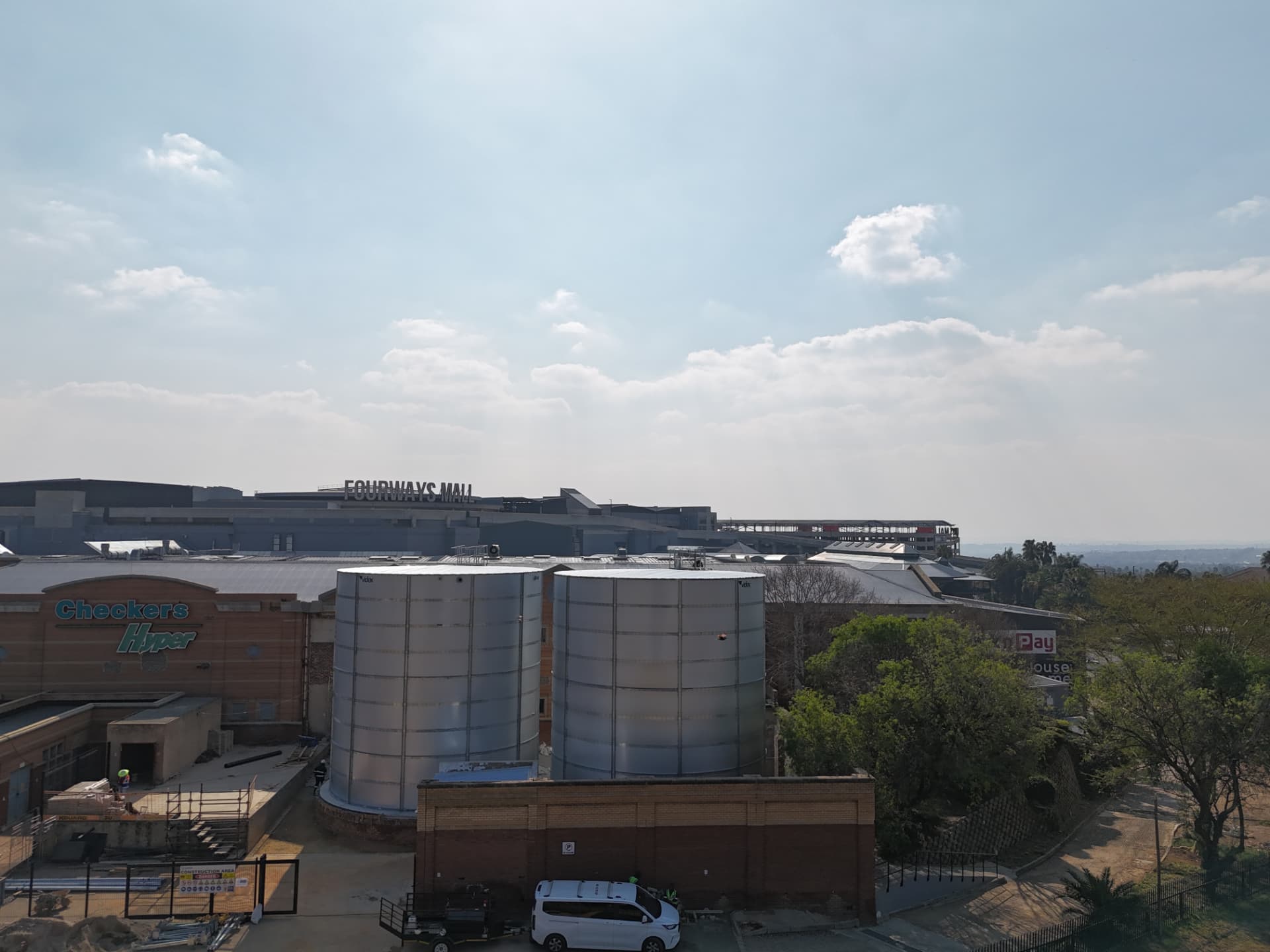
- Fourways Mall: a 1.85 million litre bulk water storage system in Sandton.
Frequently asked questions
Which is cheaper, a sectional or a round steel tank?
It depends on the capacity, the site and the specification, including foundations, compartments and fittings. Where a site can take either type, ask for both to be priced on the same effective capacity.
Can both tank types store drinking water?
Yes. Both are used for potable water storage. In a round tank the water is held in a food-grade PVC liner. In a sectional tank it is held by the galvanised steel panels. Your engineer will confirm the right specification for the water quality required.
Can both be used as fire water tanks?
Yes. Both types are used for sprinkler water supplies. Sectional tanks are often chosen where the fire design calls for a split, two-compartment tank. Read our fire protection water storage tanks page for more.
What standard are Videx steel tanks designed to?
Videx sectional and round steel water tanks are designed to SANS 10329. Sectional tank panels are hot-dip galvanised to SANS 121.
Can a sectional tank be made larger later?
Sectional tanks are modular, so their dimensions are flexible at the design stage. Extending an existing tank depends on its design and foundation, so plan for future capacity before the tank is built.
This article provides general guidance only. The right tank type for your project depends on site conditions, water quality and design requirements, which should be confirmed by a qualified engineer.
About this article
Written by the engineering team at Videx Storage Tanks, a South African manufacturer of sectional and round steel water storage tanks based in Wadeville, Gauteng, with a branch in Bellville, Cape Town. Videx has more than 40 years of experience and more than 500 completed projects, and is ISO 9001:2015 certified.
Not sure which tank suits your site? Speak to a Videx engineer for advice on layout, capacity and specification.